
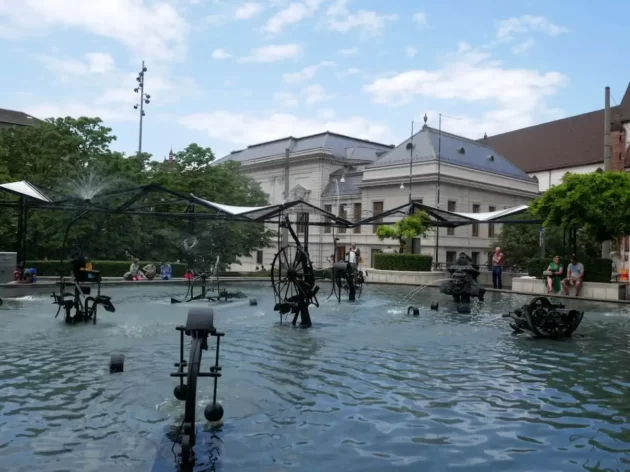
If you have ever found yourself wandering through the elegant streets of Basel, you have probably stopped next to a playful water show. Nestled in the heart of the square is a shallow public basin filled with spinning, water-spouting mechanical sculptures that seem to have a joyful life of their own. This is the Tinguely Fountain, and it serves as the perfect, enchanting introduction to the brilliantly eccentric world of Jean Tinguely.
While he might not be as famous as his contemporaries like Andy Warhol or Pablo Picasso, this Swiss artist was one of the most fascinating innovators in modern art. Tinguely took the cold and serious world of industrial machinery and turned it completely on its head. In his hands, gears, motors, and scrap metal became beautifully chaotic and unpredictable. He gave these machines a soul, a sense of humour, creating some of the most interesting artworks of the 20th century.
Life: From Basel Apprentice to Parisian Avant-Garde

Jean Tinguely’s story began in Switzerland. Born in Fribourg in 1925, he was the only child of working-class parents. The family soon moved to the lively town of Basel, a place that would shape his early worldview. Tinguely’s artistic path didn’t start in a traditional art school. Instead, it began in the real world. At the age of fifteen, he started an apprenticeship designing window displays for local department stores. This early experience with space and materials sparked his curiosity about three-dimensional art.
The following year, in 1942, he formalised his studies at the Basel Arts and Crafts School, where he studied until 1945. It was here, thanks to his teacher Julia Ris, that Tinguely discovered Dadaism. This radical movement, which started during the First World War, mocked traditional art and embraced the irrational as a response to a broken world. This playful, rebellious philosophy resonated with Tinguely and became the foundation for everything he made.
I am an artist educated by Duchamp. (Jean Tinguely)
Looking for the heart of the post-war art scene, Tinguely moved to Paris in 1952 with his first wife and fellow Swiss artist, Eva Aeppli. Paris welcomed Tinguely’s eccentric style with open arms. He quickly integrated himself into the city’s vibrant, bohemian avant-garde circles, and by 1960, he became a founding member of the New Realism (Nouveau Réalisme) movement. Alongside art critic Pierre Restany and legendary figures like Yves Klein, they wanted to break down the barrier separating high art from everyday life. Instead of painting on pristine canvases, they looked to the harsh realities of the modern world for inspiration. Tinguely soon became a celebrated fixture of the French capital, exhibiting his strange creations in prominent galleries across the city.
Even as his international fame skyrocketed, Tinguely never truly lost touch with his Swiss roots or his deeply ingrained anti-establishment spirit. Decades later, after returning to live in Switzerland in the 1970s, he found a unique outlet for his rebellious creativity outside of conventional museum walls. For nearly twenty years, starting in 1974, Tinguely actively collaborated with the Kuttlebutzer, a satirical group of artists who acted as the unofficial creative committee for the Fasnacht carnival in Basel. The carnival, known for its chaos and political mockery, was the perfect playground for Tinguely. He poured his immense talents into designing floats, masks, and street spectacles that poked fun at the political and corporate elite, keeping his art connected to the community until his death in 1991.
⤷ Read more: Weekend in Basel Filled With Art & Culture
Artwork: Satire, Spectacle, and Self-Destruction
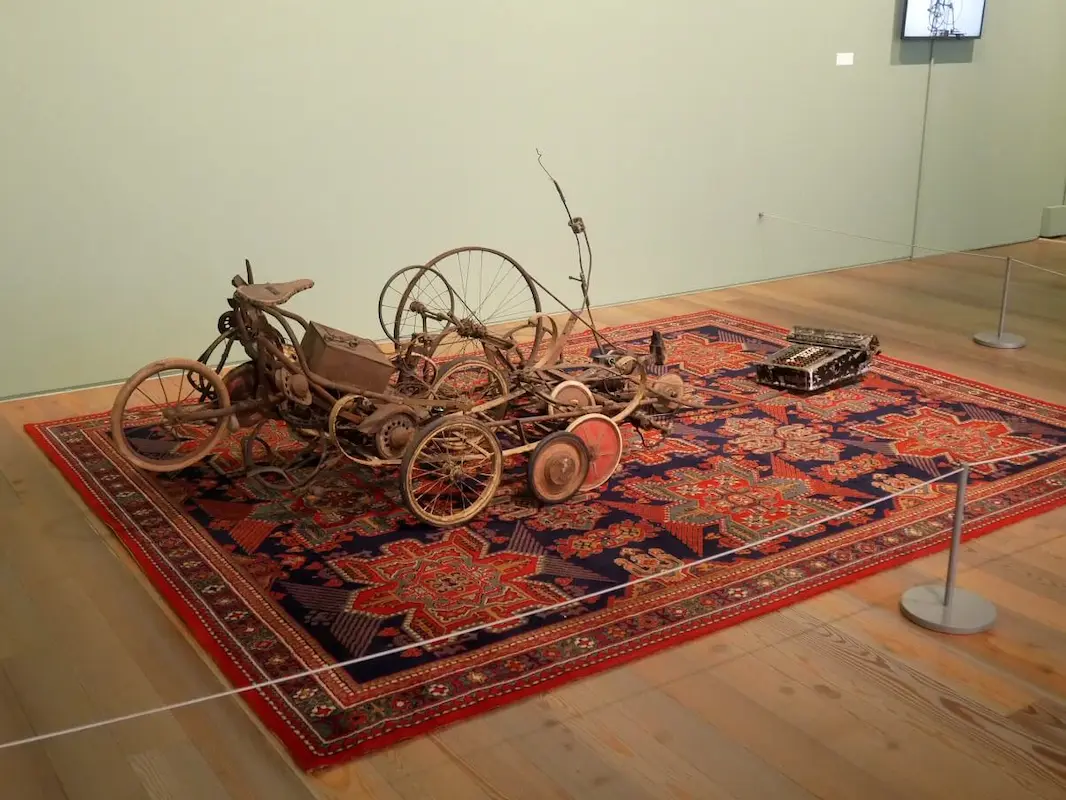
To understand Jean Tinguely’s art, you have to look at how he viewed physical objects. His early career began firmly rooted in the Dadaist practice of creating static assemblages. He would visit junkyards and flea markets, gathering the discarded objects like rusted iron bars, broken bicycle wheels, and scrap metal, welding them into abstract sculptures.
However, the mid-20th century was obsessed with industrialisation, factories, and technological progress. Tinguely looked at this obsession with efficiency and realised that static sculptures were no longer enough to capture the manic energy of the time. So, he decided to do something radical: he put these statues into motion.
By combining scrap materials with the sharp, structural influences of Bauhaus masters like Paul Klee, Tinguely created an entirely new style. His clanking, shuddering creations were made to mock the seriousness of the Industrial Revolution. Rather than doing something useful, his machines performed completely useless and repetitive movements. They were totally unproductive, and that was exactly the point. Through this irony, he questioned whether the machines we built to serve us were actually beginning to control us.
Art is the distortion of an unendurable reality… Art is correction, modification of a situation; art is communication, connection. (J. Tinguely)
As time went on, Tinguely’s ideas grew bolder, leading him to introduce elements of risk and actual self-destruction into his work. If life is constantly changing, he reasoned, then art should be too. This led to his most famous and daring performance: Homage to New York.
On March 18 1960, in the sculpture garden of New York’s Museum of Modern Art (MoMA), Tinguely unveiled a massive 8 metre (27 foot) tall kinetic installation made of bicycle parts, a weather balloon, a piano, and metal scraps. The machine’s only purpose was to exist, perform, and then destroy itself in a spectacular explosion of smoke, fire, and noise. However, the machine truly embraced the laws of chance and rebelled against its own blueprint. Just 27 minutes into the performance, a mechanism misfired, causing the artwork to catch fire and burn out of control. Firefighters had to step in to put it out, much to the delight of the crowd. Today, a charred, twisted fragment of that night sits proudly in MoMA’s collection, a monument to the beauty of failure.
⤷ Read more: Best Art Exhibitions in European Museums in 2026
The Master of Kinetic Art: The Méta-Matics
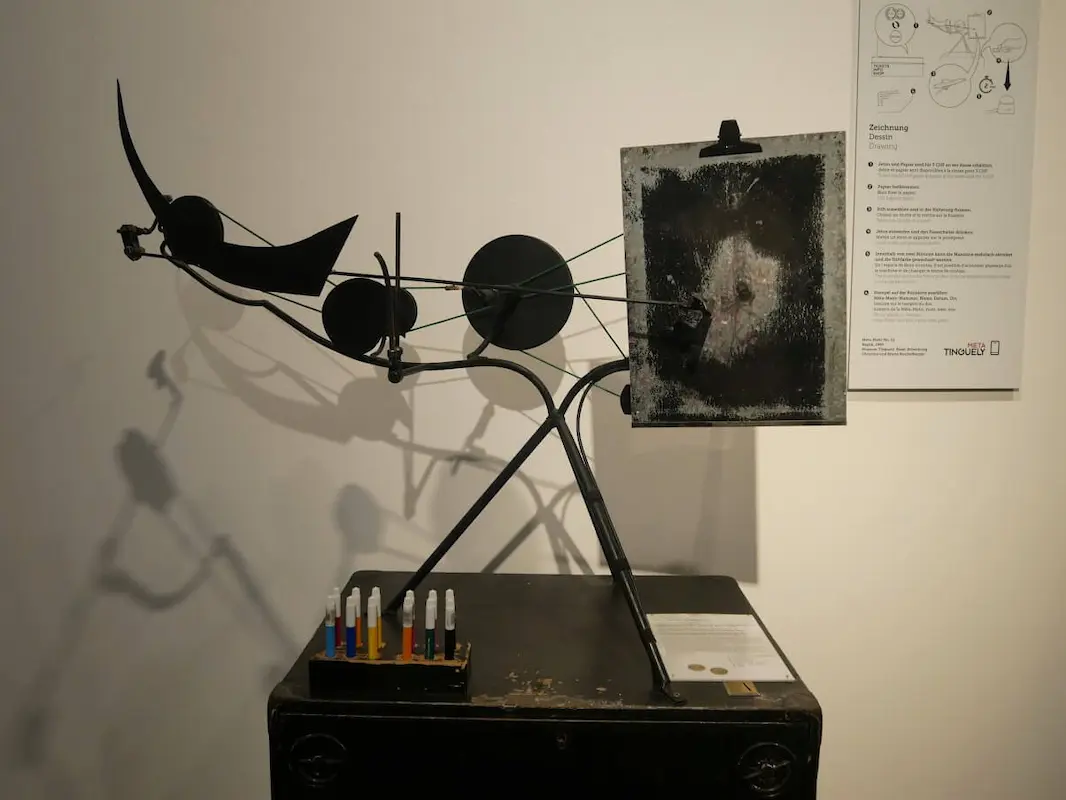
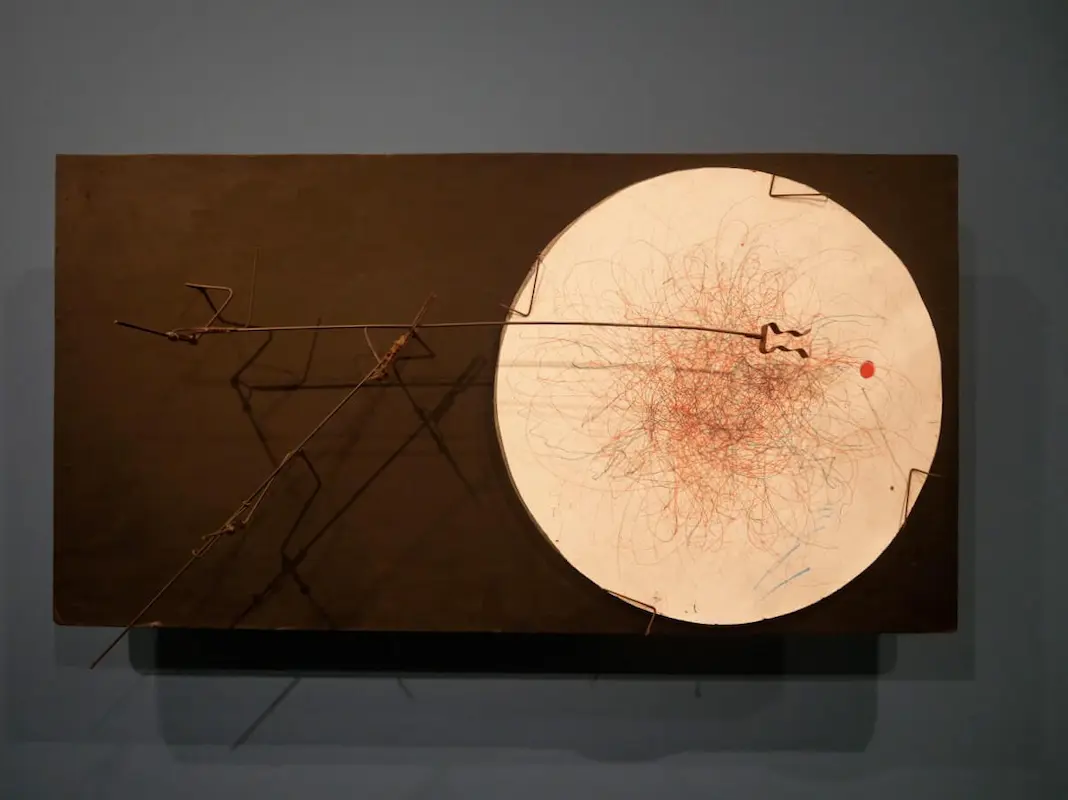
Movement wasn’t just a feature of Tinguely’s work; it was his main medium. He famously said: “The only stable thing is movement.” To fully explore this idea, he spent years creating a specific category of kinetic art called the Méta-Matics.
Built mostly between 1955 and 1959, these motorised contraptions looked like complex, old fashioned 19th-century factory equipment. But they had a clever twist, they were interactive. Viewers were invited to press a button, pull a lever, and load a piece of paper and a marker into the machine’s mechanical arms. Once activated, the Méta-Matic would jitter violently, scattering random lines and dots across the page.
The result was a completely unique piece of abstract art made by an unthinking, unfeeling machine. With a brilliant stroke of humour, Tinguely was poking fun at the serious, dramatic Abstract Expressionist painters of the day. He was asking a question: if a pile of motorised scrap metal can make a compelling abstract drawing in a matter of seconds, what does that say about the role of the traditional artist or the value of the artwork? The success of these drawing machines sparked huge interest worldwide, sparking an international art career that landed his work in major global exhibitions.
As his international fame grew, so did the size of his ambitions. In the autumn of 1978, Tinguely was invited to participate in Felix Handschin’s legendary ‘Hammer Exhibition,’ held inside a vast, disused industrial factory in Basel. Inspired by the echoing space, he wanted to create something truly monumental. This created the first of his legendary Méta-Harmonies.
Unlike his smaller drawing machines, the Méta-Harmonies were colossal, wall-sized motorised structures. Tinguely filled these massive iron frames with a chaotic mix of percussion instruments, bells, drums, cymbals, piano strings, and everyday metal objects. When switched on, they didn’t just spin gears. They unleashed a magnificent, deafening, and theatrical din. It was an all-encompassing sensory experience that blurred the lines between sculpture, music, and live theatre.
⤷ Read more: The Best Museums in Basel
Jean Tinguely’s Legacy
While Jean Tinguely’s individual work is monumental, his legacy is permanently tied to his creative and romantic partnership with his second wife, the celebrated French artist Niki de Saint Phalle. The couple married in 1971, but they have already met in the mid-1950s in the avant-garde art circles of Paris. An undeniable intellectual and creative spark drew them together, and they evolved into one of the most famous power couples in modern art history.
Immobility does not exist. Don’t be subject to the influence of out-of-date concepts. Forget hours, seconds and minutes. Accept instability. (J. Tinguely)
Together, Tinguely and Saint Phalle formed a perfect artistic balance. Where Tinguely’s work was dark, mechanical, industrial, and heavy, Saint Phalle’s work was brightly coloured, organic, and celebratory. When they collaborated, these opposing styles became pure magic. Over several decades, they gifted public spaces of the world with iconic landmarks that rejected boring, sterile city architecture.
Their most celebrated collaborations include Le Paradis Fantastique in Stockholm, a playful outdoor installation where her colourful figures interact with his dark, whirring kinetic machines. And, of course, the Stravinsky Fountain in Paris. Completed in 1983, the fountain features sixteen distinct sculptures sitting right above the underground music archives of composer Igor Stravinsky. Each whimsical sculpture represents a specific piece of his music, blending Tinguely’s mechanical waterworks with Saint Phalle’s vibrant, fantastical creatures.
Today, decades after his death, Jean Tinguely’s joyful, rebellious spirit lives on. By refusing to let art remain static or silent on a gallery wall, he bridges the gap between traditional sculpture and live performance. He forced a rapidly modernising society to pause, look at the cold mechanical world around them, and laugh at its absurdities.
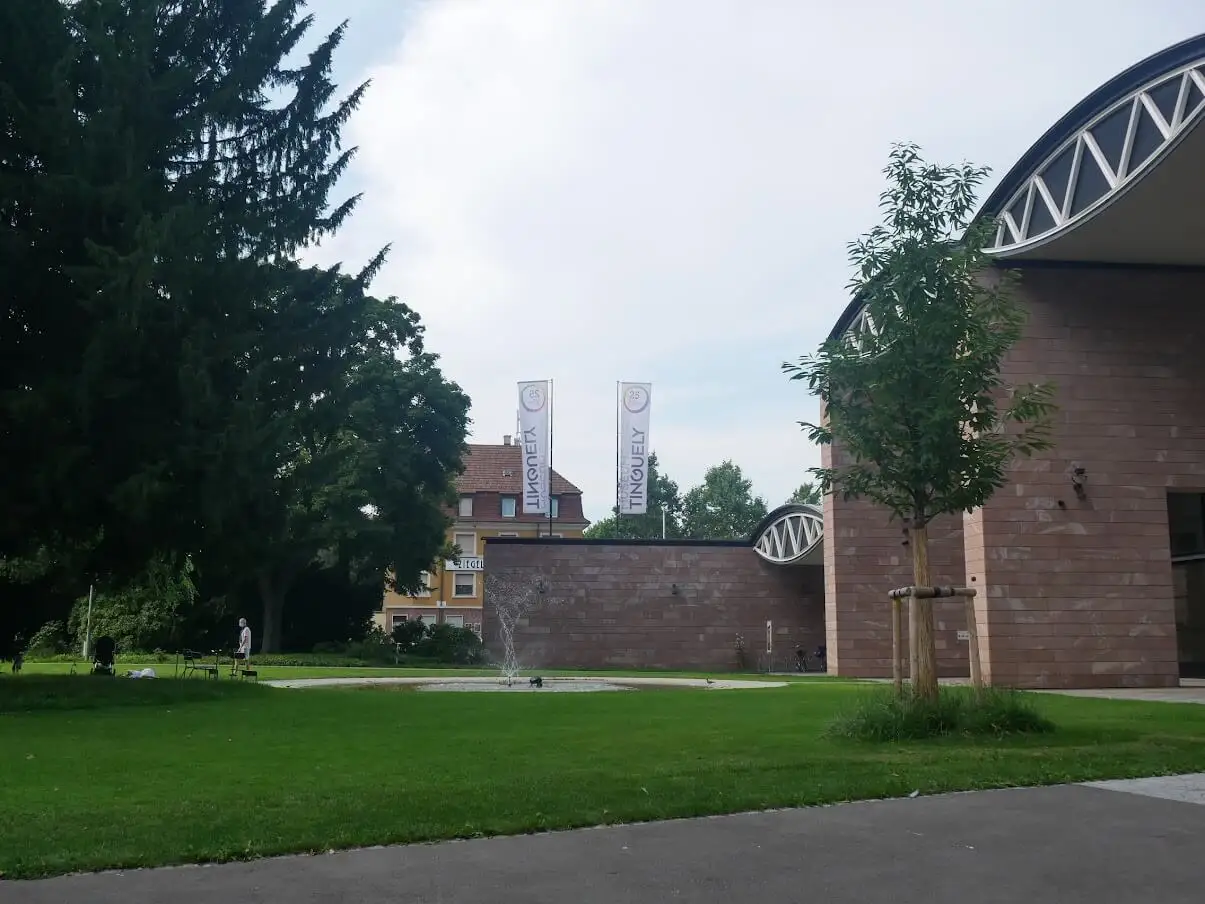
For culture lovers and art enthusiasts who want to fully immerse themselves in his kinetic universe, a trip to Basel is a must. The Museum Tinguely, located right on the banks of the Rhine in Basel, houses the largest collection of his artworks in the world. It’s a living, breathing space where his machines are meticulously maintained, still clanking, still dancing, and still celebrating the beautiful, chaotic imperfection of the human experience.