
This is a guest post by Carol M. Cram of Artsy Traveler. Many thanks to her for sharing her tips and insights about the Borghese Gallery Tour she took in Rome.
I’ve visited the Borghese Gallery three times over the years—twice on my own and once on a guided tour. And here’s my recommendation: taking a tour is absolutely worth the extra cost.
Thanks to the enthusiasm and insight of our guide, Giovanna Santo from City Walkers Tours, I finally understand why the Borghese Gallery is often called Rome’s best small museum. Her stories and her passion for the art brought centuries of art and history vividly to life.
By signing up for Giovanna’s tour, I was able to visit the gallery on the morning I wanted to go, and gain a much deeper appreciation for the art than I would have gotten on my own.
A Jewel in Rome’s Borghese Gardens
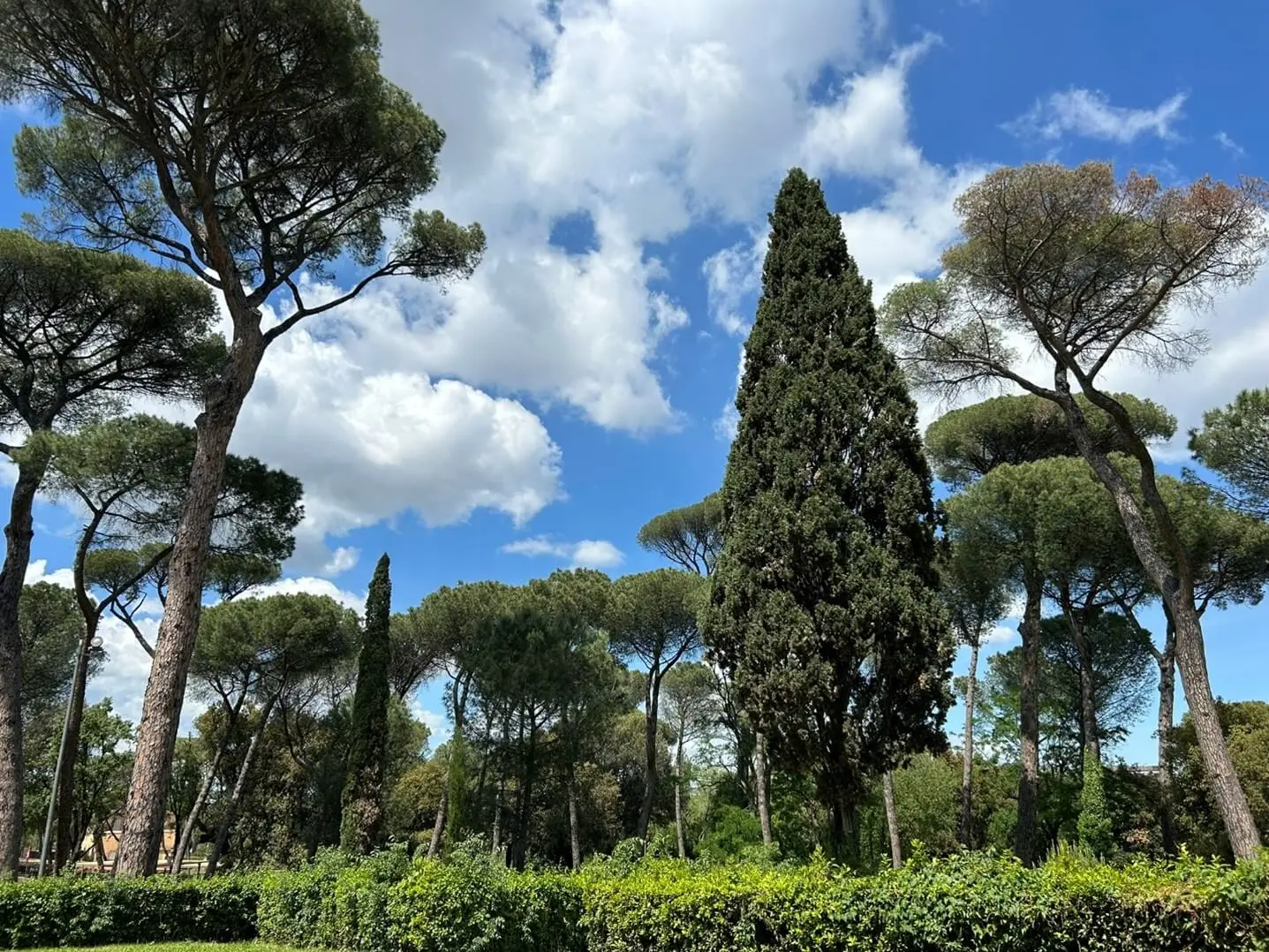
Situated in the elegant Villa Borghese and surrounded by the delightfully lush and tranquil Borghese Gardens, the Galleria Borghese is a peaceful escape from Rome’s crowds.
The Gallery is a must-see if you are a fan of Baroque art. I confess that I am not a big Baroque fan, being more of a medieval and modern gal, but thanks to Giovanna’s thoughtful commentary, I learned to appreciate Baroque art, particularly in the work of Bernini and Caravaggio. Works by both are highlights of the collection.
⤷ Traveler Tip: Combine your visit to the Borghese Gallery with a stroll through the Borghese Gardens. The shaded walkways and fountains are some of Rome’s loveliest.
A Brief History of the Borghese Gallery

The Borghese Gallery houses part of the exceptional collection started by Cardinal Scipione Borghese, nephew of Pope Paul V, in the early 17th century.
In its day, the villa was a villa suburbana—a lavish retreat for Rome’s elite on what was then the outskirts of Rome.
A century later, in 1808, Prince Camillo Borghese, who was Napoleon Bonaparte’s brother-in-law, was forced to sell many sculptures to Napoleon. That’s why masterpieces such as the Borghese Gladiator are now in the Louvre Museum in Paris.
Thankfully, plenty of treasures remain, including Canova’s statue of Josephine Bonaparte and one of the most impressive Baroque sculpture collections in the world.
⤷ Read more: The Louvre Museum Highlights
Visiting the Borghese Gallery: Tickets & Tours
Because entry is strictly limited to timed two-hour sessions, tickets often sell out days and even weeks in advance.
On my most recent visit, I checked the official Borghese Gallery website a week before I was coming to Rome and discovered to my surprise that the morning sessions on the day I wanted to visit were already fully booked.
The only way in? Taking a guided tour.
⤷ Pro Tip: Guided tours include skip-the-line entry and commentary that adds context and storytelling you’d miss otherwise.
Highlights of the Borghese Gallery

The Borghese Gallery’s collection spans two full floors with room after room of masterpieces. And don’t forget to look up. Some of the ceilings, many painted during the Baroque era, are truly breathtaking with incredible trompe-l’œil effects.
In this post, I focus on sculptures by Bernini and the gladiator mosaics on the first floor and then the Caravaggios and other masterpieces on the second floor.
⤷ Read more: My Travel Diary – Four Days in Rome
Bernini’s Sculptural Genius

The tour begins with Bernini’s The Rape of Persephone—a sculpture so dynamic it seems to breathe. I remember being astounded by this sculpture during my first visit to the Borghese Gallery when I was eighteen. Bernini’s ability to bring cold marble to life truly is astonishing.
Giovanna guided us around the piece, pointing out the realism in Pluto’s fingers pressing into Persephone’s thigh and the way Bernini was able to capture movement and emotion in marble.

Giovanna’s commentary is easy to understand and interactive. She keeps the group engaged with questions and points out interesting details.
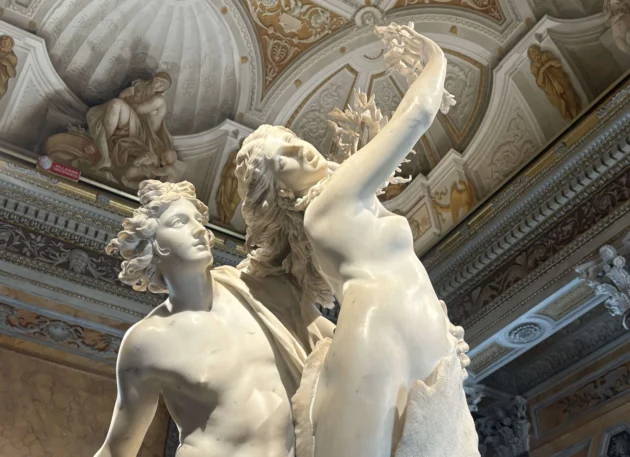
Another awesome Bernini sculpture that Giovanna explains is Apollo and Daphne (check out the cover photo). Giovanna relates the story of the myth and points out the energy and delicacy of the sculpture. Some of the marble leaves on Daphne’s hands are almost transparent.

Bernini’s sculpture of David is also remarkable. Check out the concentration on David’s face and the tension in David’s foot just before he lets the rock fly from his swing.
The Gladiator Mosaics
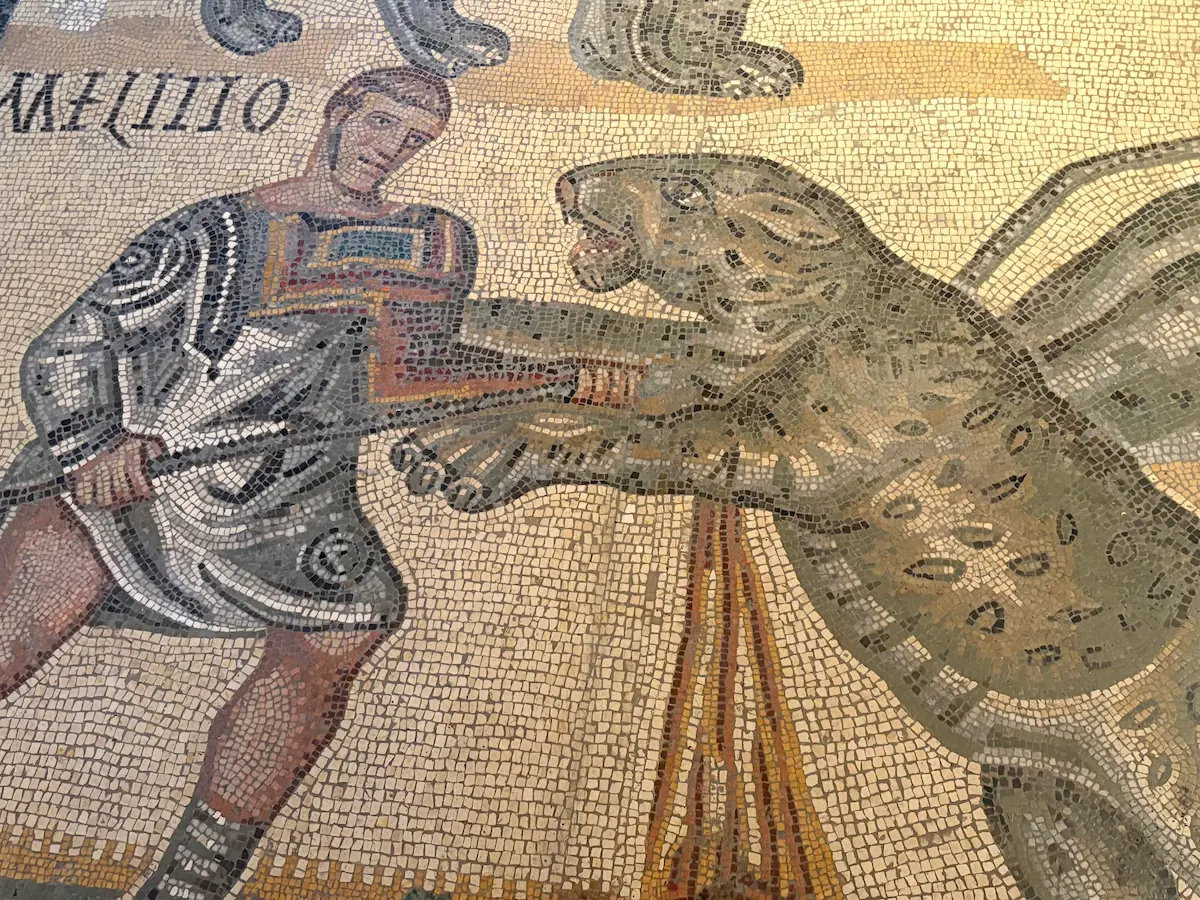
I was particularly drawn to the ancient mosaics of gladiators and hunters installed on the floor of one of the first floor rooms.
The mosaics date from Roman times and were discovered on the Borghese estate at Torrenova in the early 19th century. The five panels are vivid, detailed, disturbingly violent, and remarkably preserved.
Paintings at the Borghese Gallery
Upstairs, the focus shifts to paintings by Caravaggio, Raphael, and Titian among many others. While my energy was beginning to flag after almost ninety minutes of the two-hour tour spent on the first floor, I quickly revived as Giovanna escorted us around the various rooms.
⤷ Read more: Exploring Rome with the Urbs App
Caravaggio: Master of Light

First stop was the surprisingly small room containing four of Caravaggio’s masterpieces. The room was empty by the time we reached it so I was able to admire the paintings and listen to Giovanna accompanied only by the people on the small group tour.
Some would say, with justification, that the paintings by Caravaggio alone are worth a visit to the Borghese Gallery. Caravaggio’s revolutionary use of light and realism changed the course of Western art.
Giovanna explained how Caravaggio painted real people—wrinkled, barefoot, and imperfect—infusing sacred scenes with humanity and grit.
Here are my two favourites: Madonna and Child with Saint Anne and Boy with a Basket of Fruit.
Madonna and Child with Saint Anne
Giovanna tells us that the Church fathers didn’t want anything to do with this painting by Caravaggio. The figures were far too realistic and human to be holy.
Nowadays, we appreciate how Caravaggio uses dramatic lighting to create a sense of depth.
Boy with a Basket of Fruit
Giovanna points out the hyper-realism of the fruits spilling out of the boy’s basket. Combined with the beauty of the young boy and the starkness of the interior setting, the painting is often characterised as representing the fleeting nature of youth and beauty.
⤷ Read more: 10 Best Art Exhibitions in European Museums in Autumn & Winter 2025
Titian

One of the most famous paintings in the Borghese Gallery is the large painting by Titian (Tiziano in Italian) called Sacred and Profane Love. The painting depicts two women—one clothed and the other naked—symbolising sacred love and profane (or passionate) love. They are positioned on either side of a sarcophagus topped by a mischievous cupid.
There is a balanced perfection about the painting that I find appealing. Also, the exact meaning of all the symbols and their relationships to love remains tantalisingly elusive.
Raphael

The Borghese Gallery includes several paintings by Raphael. This one, called Portrait of Young Woman with Unicorn, was restored in the 1930s after having been heavily overpainted to depict Saint Catherine holding the wheel she was tortured on.
Originally, Raphael painted the woman (whose real identity is still not confirmed) holding a small dog, and then changed it to a unicorn, a symbol of purity and virginity. Apparently, only a virgin could tame a unicorn to sit passively in her arms.
The direct gaze of the woman and the sumptuousness of her dress make this painting compelling.
Fontana Lavinia

I am pleased to see this painting by Fontana Lavinia, one of the few (if not only) female painters included in the collection.
⤷ Read more: 16 Inspiring Female Artists From History
Why a Guided Tour Is Worth It
You can certainly explore the Borghese Gallery on your own, but a guided tour transforms the experience.
A guide who has a passion for art history provides meaningful historical context, shares the stories behind the myths, and talks about the personalities and intentions of the artists.
With limited time slots and so much to see, a tour helps you absorb more in less time.
Practical Information for visiting Borghese Gallery
- Location: Piazzale Scipione Borghese, 5, Rome
- Hours: Tuesday–Sunday, 9:00 AM – 7:00 PM (closed Mondays)
- Visit Duration: 2-hour timed entry slots
- Tickets: Advance reservations required
- Website: Official Galleria Borghese Site
Final Thoughts: Borghese Gallery or the Vatican?
If you have limited time in Rome and want to avoid excessive crowds, I recommend choosing a visit to the Borghese Gallery over battling the crowds at the Vatican Museum. Yes, the Vatican’s collection is mind-blowing, but the visitor experience is frequently a hot, tiring, and mobbed ordeal.
⤷ Read more: Vatican Travel Guide – What to See in Vatican City
Save your energy and lower your stress levels by instead visiting the Borghese Gallery and enjoying a smaller, more intimate art experience. You’ll still see plenty of masterpieces. Then, after your visit, you can stroll around the Borghese Gardens and enjoy a latte or an aperitif in one of the cafes scattered around the gardens.
And trust me on this one: take the tour. You’ll never look at Bernini or Caravaggio the same way again.
Carol Cram is the author of five award-winning novels, host of The Art In Fiction Podcast on which she interviews novelists inspired by the arts, and the creator of Artsy Traveler, a travel blog dedicated to independent travellers who love arts and culture. She lives on Bowen Island near Vancouver, Canada, with her husband, west coast painter Gregg Simpson.